
Once a year, when the accounts close, you and your fiduciary agree on a salary figure and perhaps a dividend. Your fiduciary knows the process and the rules well, but behind these decisions lies an optimization problem worth thousands that almost no one bothers to calculate.
Applying those rules correctly and running your case are two different jobs, and you shouldn't expect your fiduciary to do the optimization for you. Once we model everything, many times clients who trusted their fiduciary with their payout realise that no one had properly simulated the impact on their state pension, their health coverage, and the money they keep after corporate and personal taxes are paid.
To see what that means in money, take €100k of profit in a Luxembourg City SARL and send it out by four different routes. The table below shows what each route costs all-in on 2026 parameters, with the company in the small-company bracket.
| Route | All-in cost | What determines it |
|---|---|---|
| Dividend | 29.6% to 39.6% | Company tax first, then half your personal rate on what reaches you |
| Salary, a €36k band | 7.5% to 35.1% | Deductible for the company, then your bracket plus social contributions |
| Liquidation, above the abatement | About 33% to 39% | Company tax already paid, then half your average rate on the gain |
| Liquidation by resident heirs | 21.73% to about 29% | Company tax already paid, then the heirs' own rates and abatements |
As you can see, the same profit costs anywhere from 7.5% to 39.6% depending on the route and the household. Certain payouts use your tax brackets, others have no progressivity, and some are conditional on closing or selling the business. So which route should you use? It depends on various parameters, but today I'll show you three things that you and your fiduciary likely didn't think about: how each contribution year affects the pension formula, what your household earns, and whether the money has to leave the company at all.
A Pension Contribution Isn't Always Worth the Same
You might think a contribution is a contribution: you pay it, the pension fund takes it and gives you back the money later in the form of pension. Two problems with it. The formula doesn't calculate your pension like that, and the same year can cost you three different amounts depending on how you pay it.
Let's have a closer look at how the formula works. First, there's a flat part that depends only on your years of insurance. It's the same for everyone, worth about €680 a month for a full 40-year career in 2026. There's also a proportional part that depends on the income you insured, a small percentage of every year's insured salary, added up over the career. Underneath both sits an important number that acts as the floor. It's called "the minimum pension", €2,436 a month at 40 years, which is prorated down to 20 years and disappears below that.
Two different minimums are in play here, and they're easy to mix up. The minimum pension is what you get, the floor above. The minimum base is what you pay on: a gérant with more than 25% of the shares is an indépendant, so the social security centre calculates your contributions on the minimum wage base, about €33k a year, even at zero salary.
The flat part is why many gérants choose to pay themselves that minimum salary, and the choice holds. On a full career at the minimum base, the model gives a pension of about €2,750 a month, above the minimum pension on its own, and it values that pension at 65 at about 2.6 times the contributions paid in, recovered in under seven years of retirement. Move the whole career to a €60k salary and the pension is far higher, but the ratio drops to 2.3, because the flat part was already yours at the minimum. The less you insure, the better each euro does.
The minimum pension cuts the other way, though. It only lifts you when your formula pension sits below it, which happens when years go through at a reduced base, and until you cross it, extra contributions buy nothing.
The table below breaks the pension down for two 40-year careers in the model, one at the minimum base and one at the reduced base, which is a third of it.
| € a month, gross | 40 years at the minimum base | 40 years at the reduced base |
|---|---|---|
| Flat part | 679 | 679 |
| Proportional part | 2,067 | 689 |
| Formula pension | 2,746 | 1,368 |
| Minimum pension | 2,436 | 2,436 |
| Pension paid | 2,746 | 2,436 |
As you can see, the career on the reduced base comes out at about €1,370 a month by formula and €2,436 paid, the minimum pension doing the work, and when I add one year at an €80k salary the formula moves but the pension paid moves by exactly zero, for about €11.7k of extra contributions. The same €80k year on a career above the minimum pension buys about €73 a month for life. One year, two careers, and the difference between zero and €73 a month is where you were standing when you paid it.
The age at which you pay also changes what a year is worth, even though the formula ignores it. A year at the minimum base buys the same €64 a month whether you pay it at 35 or at 60, but the money you pay at 35 waits 30 years for its first pension payment, while the money you pay at 60 waits five. So if you value that pension on the day you pay, discounted at the rate your money could earn elsewhere, the same contribution is worth much less when you pay it early. At 4% a year above inflation, the pension bought by a year paid at 35 is worth about €3.2k on the day you pay it, against about €8.6k for the same year paid at 60, and you pay the same €7.9k both times. If you have a choice about which years carry the salary, the late ones are the better buy.
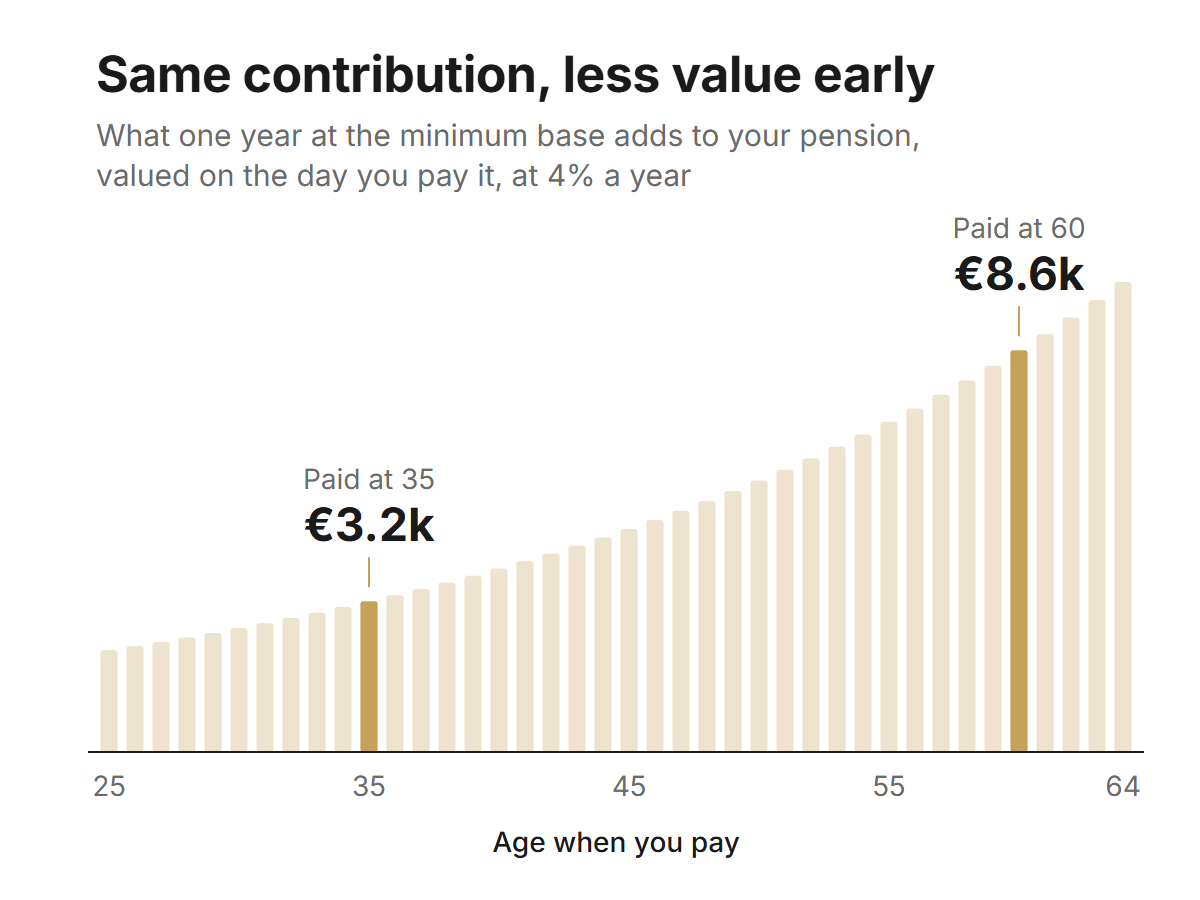
Every bar is the same year at the minimum base, €7.9k of contributions that adds €64 a month of pension from 65. The height is that pension's value on the day you pay, counting 20 years of retirement discounted at 4% a year above inflation. A lower rate lifts every bar and a higher one lowers them, but at any rate above zero the early years come out worse.
At zero salary you still pay about €7.9k a year in social contributions, and that buys a full year: it counts towards your pension, covers your health care, gives you sick pay if you can't work for more than eleven weeks, and insures you against accidents. You can ask to pay the pension part on a third of the base instead, about €4.1k a year in total. The year still counts towards the flat part and everything else stays the same, but it adds only a third as much to the proportional part. Or you can ask for a dispense and pay about €1.9k for voluntary health insurance only. That year adds nothing to your pension, gives no sick pay, and can't be bought back later, because buying back years is only allowed for family reasons.
That last route is where expensive mistakes get made. A dispense doesn't expire on its own: in one decision of the social security court, a self-employed man who was dispensed in 2016 was still dispensed when he died in 2020, and his widow was refused a survivor pension. In the model, a year at the minimum base costs about €6k more than the dispense and adds about €64 a month to your pension for life. I'm quite sure that man didn't know how expensive that decision was.
If you'd like a first number for your own career, the free State Pension calculator at pension.smoney.lu estimates your gross state pension at 65 from your career periods.
But let's save it for later, and get back to the numbers you pay yourself.
Salary or Dividends Depends on What the Rest of Your Household Earns
You'll hear that dividends are cheaper, or that a salary up to a fixed amount is optimal, and both rules ignore an important parameter, which is the person with whom you file taxes jointly. A dividend pays two layers: the company's tax first, then half of what reaches you at your personal rate, and because the 15% withheld at source is credited but never refunded, a return with little other tax in it pays at least that 15%.
A salary skips the company layer, because it's deductible, but it then goes through your brackets with social contributions on top, and you've just seen that the pension part of those comes back. So the real question isn't which route is cheaper in general. It's how full your household's brackets already are when the salary arrives, and under joint taxation your partner's income fills them first.
The table below shows two households with the same company, €120k of profit and the same €36k salary, and the only difference between them is the partner's income.
| Household A | Household B | |
|---|---|---|
| Partner's taxable income | €15,000 | €80,000 |
| What the €36k salary costs, tax plus social | 7.5% | 35.1% |
| What a dividend costs instead, all-in | 34.0% | 35.0% |
| Net cash, salary against no salary | Gains about €11,000 | Loses about €1,800 |
Read across the rows, and you can see that the company and the salary are identical while the household decides the answer. In household A the salary is almost free, because the brackets are empty, and it beats the dividend by about €11k a year. In household B the partner has already filled the brackets, so the same salary costs more than four times as much and the dividend wins by a little. A rule such as "pay yourself up to X" can't be right for both.
A token salary gets the worst of both, because your contributions are calculated on the minimum base whatever you earn below it, so a small salary only adds income tax. The choice is zero salary, or a salary that fits under your household's brackets, and nothing in between.
When the salary does fit, it pays for years. In one case I ran, a salary in the right band plus a small dividend left the household with about €176k more net cash over 15 years than leaving everything inside the company, counting the tax effect alone, in today's euros.
Delaying a Distribution Has a Cost, and Sometimes It Pays
You might think cash in your hand beats cash in the company, so you take the profit out every year. That works when the year is cheap, but the company pays its own tax in the year it earns the profit whether you distribute or not, so what you're deciding each year is only when the personal layer arrives, and at what rate.
A liquidation can be the cheapest place for it to arrive. Closing or selling the company is a disposal of your shares, not a dividend, so nothing is withheld, an abatement of €50k per person (€100k for a couple, once per rolling ten years) comes off the gain, and the rest is taxed at half your average rate. Resident heirs who liquidate later do so at their own rate and with their own abatements, which on my reading is how a pot can leave at close to nothing on top of the company's tax.
Waiting isn't free, though. Net wealth tax runs on the money every year it stays inside, and if you need the cash meanwhile, a documented loan from your company to yourself at the central bank's rate costs about 1% a year of the balance in tax. So the question is whether the rate you save by waiting beats the meter times the years you wait.
Here is what that looks like on a pot of €250k of already-taxed profit, for a couple whose income today sits in the top bracket. Distributing it all now costs about €57.5k in personal tax. Keeping it and liquidating in five years, in a year when the household's other income is low, costs about €21k. The €36k difference pays for about 15 years of the meter, so five years of waiting is comfortably inside it.
That's why the rule is to defer toward a scheduled cheap year, such as a low-income year, the liquidation or the heirs, and never toward "eventually", which isn't a tax year. Deferral never removes the exit, so the question is always which exit is cheapest and whether you can name its date. In one case I ran, on a pot of about €1m, the exit posture alone was worth about €56k against leaving everything inside until the end.
Why the Answer Is Different Every Time
Every figure above rests on inputs that differ from one gérant to the next. Your household's other income and tax class determine how full the brackets are, and your pension position decides whether a contribution year is a bargain, a repair or a waste.
The size of the pot determines whether the abatement shelters it, and whether you have heirs, and where they live, decides the exit. Whether you own more or less than 25% of the shares determines whether the minimum base applies, and any means-tested aid in the household turns one dividend in the wrong year into a cliff.
Each of these moves the result by points, and the three this article has followed can reverse it, which is why no standing answer exists and why the answer has to be rerun when any of them changes. If you live in France, Belgium or Germany and run a Luxembourg SARL, none of the arithmetic above transfers, because a non-resident pays a flat treaty withholding and then the residence state's own tax, and the whole analysis has to be redone from there.
How I Run It
I run this in a simulation model I built. It follows the company's cash and the household's tax position year by year over the horizon, with the salary, the dividend years, retained profit, the shareholder loan and the liquidation side by side. It values the pension on the national pension fund's formula at the parameters of the award year, tracks the health cover you hold in each year, and costs the exit.
The output is household cash at the horizon, and I compare the decisions one at a time rather than adding them up, because each one sits on its own basis. The model is a sandbox, and what comes out of it is a position, not a rule: it tells you what each choice costs on your numbers today, and it needs rerunning when they change. The figures in this article are one case and two synthetic households, not a forecast for yours.
Conclusion
As the first table showed, the same €100k of profit leaves a Luxembourg SARL at anywhere from 7.5% to 39.6%, and what decides it is the pension year, your household's other income and the need to take the money out at all, none of which shows up in a yearly salary figure. Tomorrow you can ask your fiduciary two things: where this year's salary sits against the minimum pension, and what the same money would cost as a dividend against the other income in your return.
Whether the salary, the dividend and the exit date hold up together over 15 years is a different question, and it needs a model. So before your accounts close this year, decide whether the salary figure you're about to sign is a rule you're applying or a position you've tested.
Where to Go From Here
If you'd like that read before your accounts close, the first step is a free 30-minute Strategic Review. We look at your situation, and I tell you whether a plan would help, what it would cover and costs.
See also
Pillar 3 (111bis) vs a World ETF
See also
The Luxembourg Impatriate Regime
See also
How to Invest in Luxembourg as an Expat
Frequently Asked Questions
This article is for informational and educational purposes only. It does not constitute investment, legal, or tax advice, and it is not a recommendation of any provider or product. Smart Money Growth is a financial education service, not a regulated financial advisor. Tax and social security rules change; figures reflect published sources as of October 2026. Figures labelled as one case come from a single anonymised engagement, and the synthetic households are illustrations; neither is a forecast for your situation. Verify current conditions with a qualified professional before making any decision.

Written by Romain Lucas. Founder, Smart Money Growth. Based in Luxembourg City.
Sources:
- Luxembourg income tax law (LIR), coordinated text in force on 1 January 2026: arts. 101, 102, 115(15a), 118, 130(4), 131, 132, 154(6a)
- Code de la sécurité sociale, 2026 edition (IGSS): arts. 1(4), 173, 174, 214, 225, 244, 378
- Circulaire LIR 164/1 of 29 January 2025, Administration des contributions directes, on shareholder current accounts and the interest rate
- Circulaire LIR 131/1 of 10 July 2002, Administration des contributions directes, on the global rate (also called the average rate) and the half rate on extraordinary income
- Conseil supérieur de la sécurité sociale, decisions 2024, decision of 26 February 2024, register PESU 2023/0084 (CSSS 2024/0050), on data.public.lu
- Chambre des salariés, Les pensions de vieillesse (2026 guide): the art. 214 formula, the minimum pension and the parameter table by award year, 2013 to 2052
- CCSS, paramètres sociaux 2026: contribution rates, minimum and maximum contribution base; assurance volontaire maladie
- Banque centrale du Luxembourg, interest rate statistics (the monthly series behind the shareholder-loan rate; the sheets are overwritten each month)
- Administration des contributions directes, tarif applicable aux collectivités and the municipal business tax multipliers 2016 to 2026
- Administration des contributions directes, impôt sur la fortune minimum
- Regulation (EC) No 883/2004 on the coordination of social security systems, consolidated text